
Increasing mileage?
I don't know how many times I have said to someone starting a change in their training, "don't add more than 10% on distance per week". So I was quite surprised, when on my Instagram feed, appeared a Reel saying I was wrong! Now, there's a lot of nonsense on Social Media, but this Reel by Dr Bill Evans (PhD in Exercise Physiology) was publicising some proper scientific research involving over 5000 runners in Europe and US.
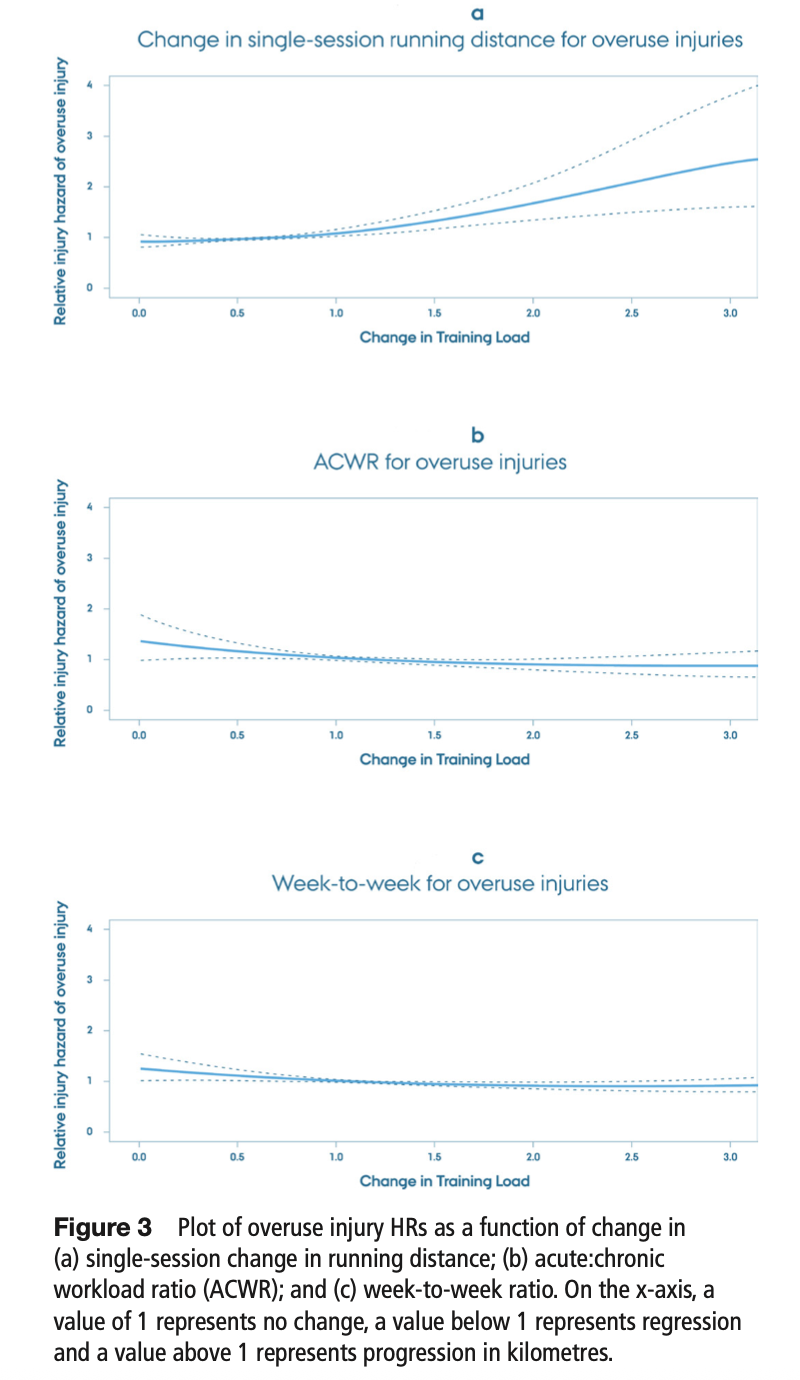
The research, "How much running is too much? Identifying high risk running sessions in a 5200-person cohort study" by Jesper Frandsen et al, was published in the British Journal of Sports Medicine, in July this year. So it's not some nonsense being used to sell training programs! The study over 18 months comprised runners mean age 46 years old (SD = 10, so will include practically everybody running in the club adult section) and 22% of the cohort were female. I think that means it is applicable to all of us.
Their methodology was to use the data from Garmins and look at the frequency of running injuries based upon grouping the runners according to how they changed their training runs. They didn't set runners up to run until they got injured! They analysed the 588,071 sessions data into three types ;
session-specific running distance relative to the longest distance run in the past 30 days;
1- week period relative to the preceding 3 weeks, using the acute:chronic workload ratio (ACWR)
1- week period using a week- to- week ratio.
Runners were categorised into one of four time-varying states:
regression, or up to 10% increase
’small spike’ between >10% and 30% increase
’moderate spike’ between >30% and 100% increase
’large spike’ >100% increase.
Outcome was self-reported overuse running-related injury. A multistate Cox regression model was used to estimate adjusted hazard rate ratios (HRR).
So what did they find out? Well slightly worryingly, 35% of cohort sustained a running related injury!
But importantly for us, it was the increase in the maximum distance of a single session compared to previous runs in 30 days, not the weekly total increase. In fact, the researchers found no correlation with increasing weekly mileage by 10%, but injury risk went up to 60 to 100% more if the runner significantly increased mileage in a single session (see grpahs above). So don't wreck your training plan by throwing in a massive increase in your long run. It's just not worth it, not only for the risk of injury but also performance, as adaptation and super-compensation only needs small increases beyond our comfort zone to provoke a beneficial strengthening. 'Too much' will take 'too long' to recover from.

Now here's a personal anecdote.
I last ran a Parkrun in beginning of May and since then I have not run at a competitive pace anything further than a mile (Bourton in early May also) or more recently (August) 400m. So my XC on Sunday at 6.4km was definitely a 'large spike' in a single session.
Did I injure myself?
No, but boy did I feel unwell that evening, because my body was unused to such a loading and felt quite strained, even at the sluggish pace I was going.
So for someone who runs 5km regularly, say Parkrun, and then decides to do a 10km race off the back of that might be in for an unpleasant surprise.
Now, I am referring to races, and the study was based on training sessions, so presumably done at a slightly lower intensity.
So please don't suddenly increase your longest running session more than 10%. It would be better to add 5% to all your sessions in a week than adding 25% to just one.
So from now on I won't be saying anything about weekly mileage increases risks, just individual sessions'.
Dorian



Comments